
7.1 Radioisotopes#
What are isotopes?#
Atoms that have same atomic number (\(Z\)), but different atomic mass (\(M\)), i.e., isotopes of the same number of protons (\(\ce{p+}\)), but different number of neutrons (\(\ce{n^0}\)). For example, the element hydrogen has three isotopes: \(\ce{_1^{1}H}\) (protium), \(\ce{_1^{2}H}\)(deuterium), and \(\ce{_1^{3}H}\) (tritium). By convention, the atomic number is shown in lower left side of the element symbol, while the atomic mass is shown on upper left side of the element symbol. Since, isotopes of the same element have the same atomic number, often the atomic number is not shown. The common way to show the hydrogen isotopes would be: \(\ce{^{1}H}\), \(\ce{^{2}H}\), and \(\ce{^{3}H}\). In literature, you may also come across other naming conventions such as \(\ce{C-14}\) or \(\ce{U-238}\).
In calculation of atomic mass of an element, relative abundances of all isotopes and their respective masses are used to calculate a weighted average.
Example: Calculation of atomic mass
Naturally occurring hydrogen is found to consist of three isotopes:
\(\pu{99.9885 \%}\) whose isotopic weight is \(1.007825\)
\(\pu{0.0115 \%}\) whose isotopic weight is \(2.01410178\)
\(\pu{0 \%}\) whose isotopic weight is \(3.016049277\)
Let’s calculate the atomic weight of an average naturally occurring sample of a hydrogen atom. We can calculate the weighted average as follows:
What are Radioisotopes?#
The number of neutrons in the nucleus of an element can be variable, giving rise to isotopes. Many isotopes are not stable and some will spontaneously transform from one form to another. This process is termed radioactive decay, and an isotope that undergoes radioactive decay is termed a radioisotope.
In the example of \(\ce{H}\) isotopes is a radioisotope. Similarly, \(\ce{^{14}C}\) is a radioisotope of \(\ce{C}\), that is employed in many geological and environmental applications. Within the periodic table, majority of the elements have stable and radioisotopes. All elements with \(Z>83\) are radioisotopes. The elements \(\ce{Tc}\) (\(Z=43\)) and \(\ce{Pm}\) (\(Z=61\)) have no stable isotopes.
Decay Mechanisms#
Why are radioisotopes unstable? The nucleus of a radioisotope is unstable because the total energy content of its nucleus is greater than that of a neighboring stable nucleus. There are several processes by which a radioisotope can become stable. When radioisotopes decay, they release various forms of subatomic particles as well as energy. For example, Fig. 50 shows how decays into more stable isotopes.

Fig. 50 Decay sequence of naturally-occuring \(\ce{^{238}U}\) into daughter products as well as the release of various types of subatomic particles. Image source: Decay chain - Wikipedia#
This decay process can be shown as a chemical reaction:
Radioisotopes of low mass numbers generally attempt to become stable by beta (\(\beta\)) decay. There are two forms of \(\beta\) decay. In beta- (\(\beta^-\)) decay a neutron (\(\ce{n^0}\)) converts into a proton (\(\ce{p+}\)) and an electron (\(\ce{e-}\)) as shown below.
Example: \(\beta^-\) decay
The isotope \(\ce{^{14}C}\) decays in this manner.
Because the neutron converts to a proton, the mass number of the isotope does not change, but the atomic number increases by 1.
In beta+ (\(\beta^+\)or positron) decay, a proton (\(\ce{p+}\)) can decay into a neutron (\(\ce{n^0}\)) and a positron (a positively charged electron, \(\ce{e+}\)). Again, the mass number does not change, but the atomic number decreases by 1 as there is one less proton in the nucleus as shown below.
Example: \(\beta^+\) decay
The isotope \(\ce{^{18}F}\) decays in this manner.
The mass number did not change, but the atomic number decreased by 1 as there is one less proton in the nucleus.
A proton can also convert into a neutron by capturing an orbiting electron, emitting X-ray radiation in the process as shown in the reaction below. This process is called electron capture.
Example: Electron capture
The isotope \(\ce{^{18}F}\) can capture an \(\ce{e-}\) and emit X-rays as shown below.
The mass number did not change, but the atomic number decreased by 1 as there is one less proton in the nucleus.
Neutron-rich radioisotopes tend to undergo decay by \(\beta^-\) decay process, whereas neutron-poor radioisotopes undergo \(\beta^+\) decay or electron capture. Many radioisotopes require repeated \(\beta\) decays to become stable. For example, radioactive \(\ce{_{54}^{140}Xe}\), which undergoes four successive \(\beta-\) decays to form stable \(\ce{_{58}^{140}Ce}\).
For the heavier radioisotopes the number of beta decays would be enormous, and so they undergo a different kind of radioactive decay process. This is known as alpha (\(\alpha\)) decay and involves the ejection of an \(\alpha\) particle (i.e., \(\ce{_2^{4}\alpha}\) or \(\ce{_2^{4}He}\)) from the nucleus.
Example: Alpha decay
The isotope \(\ce{_{94}^{239}Pu}\) decays to \(\ce{_{92}^{235}U}\) by this process.
The loss of means that the mass number decreases by 4, whereas the atomic number decreases by 2.
The \(\alpha\) particle is ejected at speed, and due to its mass is the most ionizing but the least penetrating form of radiation. A sheet of paper can block this form of radiation.
Another form of radioactive decay is that of spontaneous fission. In this process, a heavy radioisotope will split into two medium-weight nuclei, which are called fission products. These are commonly radioactive themselves.
Example: Spontaneous fission
An example is the fission of \(\ce{_{98}^{252}Cf}\), which splits with the emission of two neutrons.
The atomic numbers of cadmium (48) and tin (50) add up to the atomic number of californium (98) because there is no change in the total number of protons, and the total mass of the products including the two neutrons adds up to 252, the mass number of \(\ce{_{98}^{252}Cf}\).
The last form of radioactive decay is that of gamma (\(\gamma\)) decay. Here, the radioisotopes are in an excited (i.e., high-energy) state. The majority of alpha and beta decays result in excited-state daughter nuclei, and these lose energy to go to their ground (i.e., low-energy) state by emitting gamma (\(\gamma\)) radiation. This gamma radiation is actually very-short-wavelength electromagnetic radiation similar to X-rays.
Example: Gamma decay
An example is the decay of \(\ce{_{55}^{137}Cs}\) by \(\ce{_{-1}^{0}\beta}\) decay to \(\ce{_{56}^{137}Ba}\), which then emits \(\gamma\) radiation to lose energy
Name |
Symbols |
||
|---|---|---|---|
Proton |
\(\ce{p^+}\) |
\(\ce{H+} \) |
|
Neutron |
\(\ce{n^0}\) |
||
Beta- |
\(\beta^-\) |
\(_{-1}^0\beta\) |
\(\ce{e-}\) |
Beta+ |
\(\beta^+\) |
\(_{+1}^0\beta\) |
\(\ce{e+}\) |
Alpha particle |
\(_2^4\alpha\) |
\(\ce{_{2}^{4}He}\) |
|
Gamma particle |
\(\gamma\) |
Quantifying Decay#
Radioactive decay is a random process, and it is not possible to predict when any one particular atom will decay. The rate at which a particular radioisotope decays obeys first order kinetics. If the number of isotope atoms are represented as \(N\), the rate of decay can be expressed as follows:
where, \(\lambda\) is the radioactive decay constant (similar to the rate constant, \(\kappa\) described in the previous chapter.) We can integrate the above equation and derive the following solution:
where, \(N_0\) is the number of unchanged atoms at \(t=0\), and \(N_t\) is the number of atoms available at time, \(t\).
Since, the radioisotope is unstable and decaying according to first order kinetics, the time required for an isotope to reach half it’s original mass or concentration is called half-life. That is, at half-life, \(N_t = \dfrac{N_0}{2}\). If we make appropriate substitutions to Eq. (69),
Consider the radioactive decay of \(\ce{^{238}U}\) to \(\ce{^{234}Th}\). \(\ce{^{238}U}\) is the radioactive parent and \(\ce{^{234}Th}\) is the radiogenic daughter. For any closed system at time \(t\), the number of daughter atoms produced plus the number of parent atoms remaining must equal the total number of parent atoms at the start. If we substitute \(D\) for the number of daughter atoms produced in Eq. (71), we get
If we assume that the \(D\) is not a radioisotope, we can simplify Eq. (69) to determine the number of daughter atoms formed as the parent atoms decays
The relationship between the decay of a radioisotope and the growth of a daughter can be seen in Fig. 51.
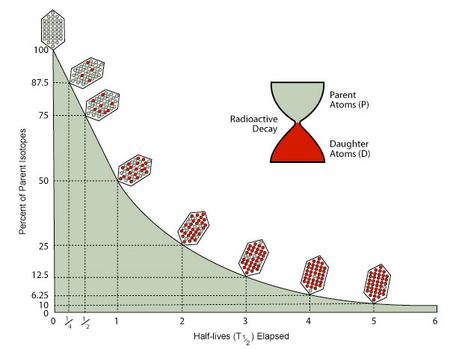
Fig. 51 Graphical representation of decay of a radioisotope (\(N\)) and the growth of a radiogenic daughter (\(D\)). Image source: Geochronology (carleton.edu)#